Frontend
React 19 and TypeScript provide the SPA workspace for accounting, treasury, ticketing, BSP, services, agents, reporting, security and platform operations.
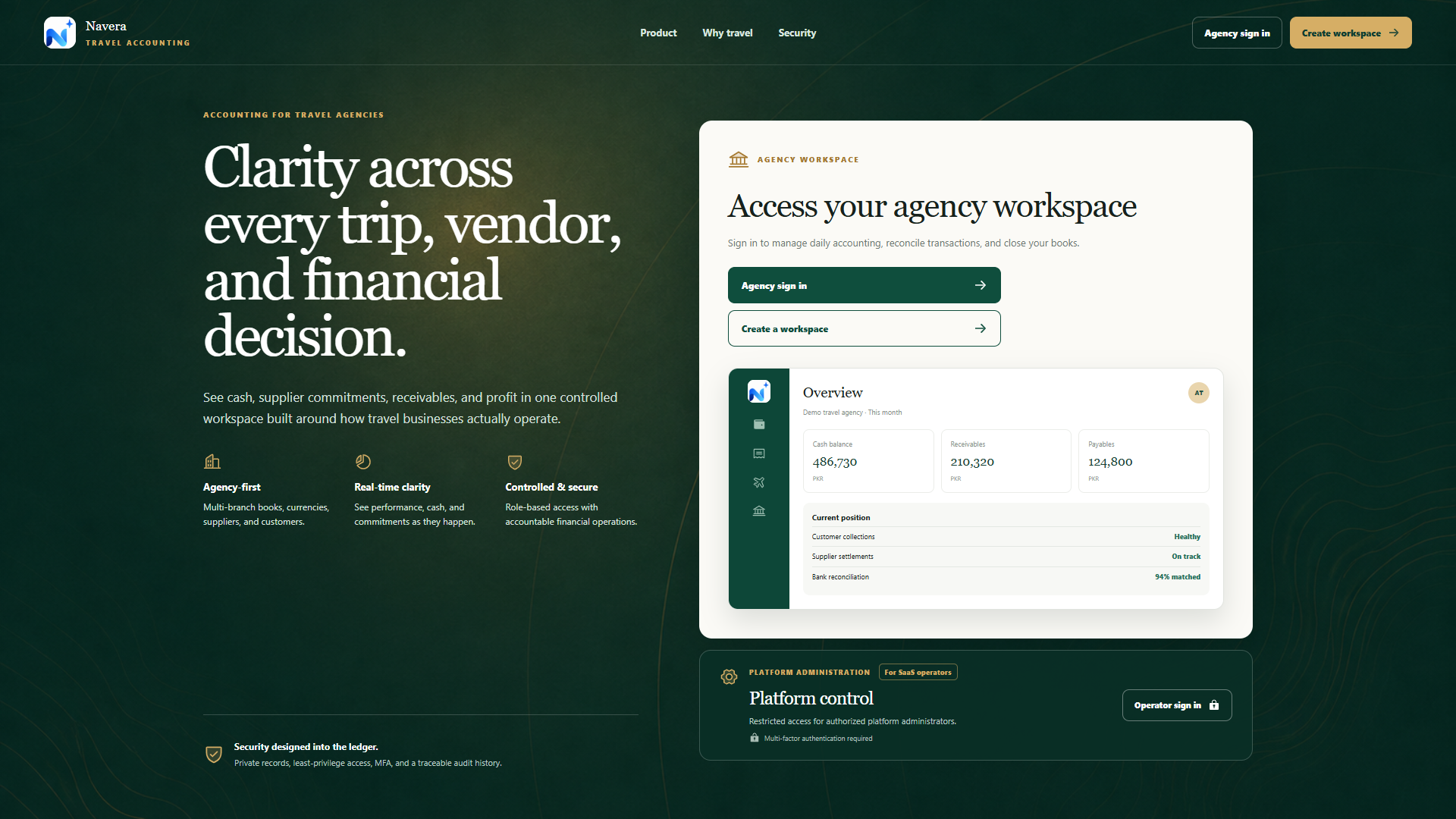
Navera by Cyber Edge is travel agency accounting software. It brings travel sales, supplier balances, expenses, cash, banking, profitability, annual subscriptions, tenant isolation and financial reporting into one controlled accounting workspace built for travel agencies.
Navera has an implemented and tested production-ready codebase baseline. It is not presented as publicly deployed, certified for all BSP formats, a tax-compliance product, an automatic exchange-rate service or a live external integration.
My Role
Product architect, Laravel API developer, React product designer and accounting workflow designer
Purpose
Dedicated accounting system for travel agencies that need ticket, BSP, customer, supplier, agent, cash, bank, expense, multi-currency and reporting controls in one structured workspace.
Business Problem
Travel agencies often track ticket sales, customer balances, supplier dues, BSP statements, agent commissions, branch cash and expenses across spreadsheets, WhatsApp notes and disconnected ledgers. This creates weak visibility, reconciliation delays, payment mistakes and unreliable owner-level reporting.
Objectives
Centralize travel-agency accounting records without presenting Navera as a CRM replacement.
Connect tickets, customers, suppliers, BSP statements, payments, expenses and reports.
Support owner, manager, accountant and branch-level controls.
Improve visibility into receivables, payables, cash, bank balances and profit.
Support annual subscription discussions without inventing public pricing.
Keep external integrations and accounting truth behind controlled API and webhook boundaries.
System Architecture
React 19 and TypeScript provide the SPA workspace for accounting, treasury, ticketing, BSP, services, agents, reporting, security and platform operations.
Laravel 13 provides the REST API, validation, accounting services, migrations, queues, production readiness checks and operational command layer.
Laravel Sanctum secures workspace sessions and API access.
Tenant, legal-entity, branch, role and permission boundaries protect agency accounting work.
MySQL is the financial source of truth for tenants, users, accounts, journals, customers, suppliers, cash/bank records, tickets, BSP records, services, agents, expenses, assets, currencies, reports, audit events and subscription controls.
Double-entry accounting is authoritative. Posted journals are immutable through ordinary workflows, corrections use reversals, and missing posting profiles fail closed.
Navera includes tenant-bound machine identities, least-privilege scopes, idempotency controls, read-only invoice and receipt feeds, signed webhooks and immutable integration evidence.
Technology Stack
Selected for a maintainable API layer, Eloquent relationships, validation, queues, commands, tests and production hardening patterns.
Selected because the accounting workspace needs rich operational screens, stateful forms, visible validation and modular interfaces.
Selected for relational accounting records, ledgers, statements, balances and report queries.
Selected for cache and queue infrastructure where supervised background work is required.
Selected for secure SPA authentication and API session boundaries.
Database Design
Tenant records isolate each agency accounting workspace.
Legal entity and branch records support the approved first commercial slice: one legal entity with one or more branches.
Chart of accounts provides the structure for cash, bank, customer, supplier, expense, revenue and adjustment ledgers.
Journal entries and journal lines provide the authoritative double-entry record.
Customer invoices, receipts and allocations support receivables and aging reports.
Supplier bills, payments and allocations support payables and supplier statements.
Cash, bank, statement and reconciliation records support treasury visibility.
Ticket and booking records connect customers, suppliers, agents, fare amounts, commission, payment state and profitability.
BSP records support fail-closed import preparation, settlement, matching and discrepancy review.
Receivable and payable records connect invoices, receipts, supplier bills, payments and outstanding balances.
Currency and exchange-rate records support controlled multi-currency transaction entry without claiming automatic live-rate updates.
Platform subscription records support annual plan versions, invoices, payment evidence, renewal history, reversals, quotas and suspension controls.
Audit and security evidence records preserve sensitive financial and privileged workflow history.
Core Modules
Modules are grouped by business responsibility so the product remains understandable and easier to extend.
Agency Accounting Workspace
Legal Entities and Branches
Chart of Accounts
Double-Entry General Ledger
Journals and Opening Balances
Accounting Period Controls
Ticket Accounting
BSP Reconciliation
Customer Receivables
Supplier Payables
Agent and Commission Tracking
Cash and Bank Ledgers
Bank Statement Handling
Expenses
Fixed Assets
Tax Configuration
Multi-Currency Transactions
Financial Reports
Roles and Permissions
Privileged MFA
Annual Subscription Control Plane
API and Webhook Boundary
Production Readiness Console
Security
Accounting data is protected behind authenticated application access.
Role permissions restrict sensitive accounting actions by responsibility.
Server-side validation protects financial forms and prevents incomplete accounting records.
Agency financial records, balances, vouchers, documents and reports remain inside controlled workspace boundaries.
Agency-owned accounting data must stay separated from every other agency workspace.
Platform administrator access requires MFA, recovery controls and step-up authentication for sensitive flows.
Pilot onboarding should verify opening balances, account mapping, BSP samples and approval responsibilities before live financial reliance.
Engineering Challenges
Keeping Navera focused on accounting instead of turning it into a CRM replacement or generic ERP.
Designing double-entry, ticket, supplier, BSP and agent flows so financial reporting remains traceable.
Supporting multi-currency transactions without overclaiming automatic live exchange-rate capabilities.
Building integration boundaries that allow external systems to submit operational data without directly posting accounting truth.
Preparing safe pilot onboarding because accounting systems need stronger validation, evidence and security than ordinary marketing websites.
Screenshots
The public case study uses a sanitized Navera product visual. Do not expose customer records, balances, credentials, MFA setup screens, payment evidence or private financial documents.
Technical Achievements
Implemented a dedicated accounting product direction for travel agencies.
Separated accounting workflows from CRM, marketplace and creative operations products.
Documented double-entry, ticket, BSP, receivable, payable, cash, bank, agent, service and reporting boundaries.
Prepared production-readiness controls including health checks, security headers, backup evidence, queue/scheduler supervision and operations visibility.
Defined annual subscription control-plane boundaries without merging platform billing into agency ledgers.
Completed
Phases 0 through 18 implemented in the product repository.
Double-entry General Ledger foundation.
Accounts receivable and accounts payable foundations.
Cash, banking and reconciliation foundation.
Ticket, BSP, service and agent accounting foundations.
Multi-currency, expenses, assets and reporting foundation.
Identity, tenant isolation, privileged MFA and security evidence.
Annual subscription control plane.
API and webhook integration boundary.
Production readiness and release control foundation.
Future Roadmap
Production domain, host, managed database, Redis, private storage, SMTP and monitoring setup.
Pilot onboarding with real sample ledgers, opening balances and BSP files.
Qualified accountant review of chart-of-accounts templates, tax configuration and reports.
Optional Ornexa CRM integration after the signed API contract, credentials, mapping and acceptance tests are finalized.
Penetration testing, privacy terms, retention policy and customer data-processing terms.
Payment gateway, bank feed or ticketing integrations only after provider credentials and commercial scope are approved.
Project Discussion
Share your business problem and I will help identify the right architecture, workflow and delivery path.