Frontend
Blade, Tailwind CSS, Alpine.js and Inter provide a responsive workspace interface for projects, conversations, knowledge, files, memory, tasks, agents, campaigns and operations.
Orhan AI is a project-centered intelligence and growth operations platform that brings organizational knowledge, conversations, files, operational memory, campaigns, content, sales activities, analytics, workflows and integrations into one controlled environment.
Advanced pre-release development with internal/local deployment. Production launch remains pending while live provider activation, external integrations, infrastructure, monitoring and end-to-end acceptance testing are completed.
Pre-Release Build
90%
Launch Readiness
75%
My Role
Product architect, UI/UX designer, Laravel developer, growth operations architect, AI integration designer and technical case-study writer
Purpose
Project-centered operating platform where each workspace and project can manage knowledge, conversations, files, memory, tasks, agents, campaigns, sales activity, analytics, workflows and integrations.
Business Problem
General-purpose chatbots treat every conversation as a separate prompt session. Business teams also split knowledge, content production, approvals, sales follow-ups, analytics and integrations across disconnected tools. The result is repeated context, weak traceability, inconsistent campaigns and AI output that is not grounded in the real operating state.
Objectives
Organize intelligence around workspaces and projects instead of isolated chat sessions.
Connect conversations, knowledge, files, memory, tasks, agents, campaigns, content, sales, analytics and integrations around each project.
Provide controlled workflows with approval checkpoints, retries, cancellation, failure classification and human oversight.
Connect campaign activity with sales activity and measurable performance evidence.
Prepare OpenRouter-based model execution while making clear that live AI generation requires provider credentials and production configuration.
Prepare the product for production launch without claiming public deployment or autonomous production readiness.
System Architecture
Blade, Tailwind CSS, Alpine.js and Inter provide a responsive workspace interface for projects, conversations, knowledge, files, memory, tasks, agents, campaigns and operations.
Laravel 12 and PHP 8.2 manage routing, validation, authorization, workspace operations, campaign workflows, sales records, AI orchestration, queues and provider boundaries.
Secure authentication and account management protect user access and support automatic workspace creation.
Workspace and project authorization ensures users can only access approved projects, files, memory, campaigns, sales records, workflow runs and agent activity.
MySQL stores accounts, workspaces, projects, conversations, messages, knowledge, files, extracted text, memory records, tasks, agents, workflows, campaigns, content, approvals, sales records, analytics snapshots, integrations and audit events.
The context layer assembles project conversations, knowledge, indexed files, memory, campaign state, sales activity and search results before AI-supported execution.
OpenRouter integration and prompt templates are prepared behind backend services so model access, token tracking, cost estimation and failure recording stay controlled server-side.
Credential records, scopes, sandbox or production environments, capability approvals, sync records, webhooks and health checks provide a governed integration foundation.
Architecture Flow
The flow is documented as architecture, not as a fabricated product screenshot.
Product Flow
Planned Ecosystem Role
These integrations are planned unless explicitly described elsewhere as completed.
Technology Stack
Selected for secure authentication patterns, authorization, validation, queues, routing and maintainable product structure.
Selected for modern Laravel compatibility and stable production hosting options.
Selected to keep the first product interface simple, server-rendered and tightly integrated with Laravel.
Selected for consistent workspace layouts, responsive UI and fast iteration.
Selected for lightweight interactivity without turning the MVP into a heavier frontend application.
Selected for relational project data, access boundaries, search preparation and workflow history.
Selected to support multiple selectable AI models through one controlled provider layer. Live generation remains dependent on API keys, provider validation and production configuration.
Selected so background agent execution can run outside the request lifecycle with run history and monitoring.
Selected for Laravel asset compilation and fast frontend iteration.
Database Design
Accounts receive automatic workspaces so project context has an owner boundary from the start.
Projects own conversations, messages, knowledge records, uploaded files, extracted text, memory, tasks, agents, workflows, campaigns, content and sales activity.
Conversation messages preserve user and assistant history without treating every prompt as an isolated event.
Knowledge records store permanent reusable project facts, instructions and decisions.
File records store uploads, extracted text and indexing metadata for retrieval.
Memory records preserve long-term facts, preferences, decisions and instructions.
Tasks represent structured project work that can connect to AI assistance.
Agents store configurable instructions, capabilities, tool permissions and usage limits.
Workflow definitions, workflow steps and workflow runs preserve retry, cancellation, resume, decision checkpoints and failure classification.
Campaign records connect objectives, audiences, channels, content items, variants, revisions, approvals and metrics.
Sales records connect leads, contact information, follow-ups, scoring, attribution, conversions and duplicate merging.
Integration records store provider configuration, credentials, scope, health checks, sync history, webhook handling and lifecycle state.
Audit and usage records preserve operational metadata while avoiding unnecessary retention of full prompt and response bodies in usage logs.
Core Modules
Modules are grouped by business responsibility so the product remains understandable and easier to extend.
Secure Authentication and Account Management
Automatic Workspace Creation
Project Creation, Settings, Archiving and Restoration
Project-Based AI Conversations
OpenRouter AI Integration
Multiple Selectable AI Models
Permanent Project Knowledge
Project File Uploads and Text Extraction
Indexed File Retrieval
Project Memory
Project Search and Contextual Retrieval
Retrieval-Augmented Generation
Markdown Response Rendering
AI Tasks and Configurable Agents
Background Agent Execution
Workflow Definitions and Runs
Decision Checkpoints and Human Approvals
Brand and Product Intelligence
Campaign Planning and Lifecycle Management
Content Studio and Revisions
Creative Briefs and Media Assets
Content Calendar
Sales Leads and Follow-Ups
Lead Scoring and Attribution
Analytics Snapshots and Optimization Recommendations
Daily Action Centre
Workspace Members and Roles
Super Administrator Oversight
Governed Integration System
Signed Webhook Integration
Responsive Workspace Interface
Authorization and Rate Limiting
Security Headers
Readiness Monitoring
Automated Application Test Coverage
Security
Secure authentication and account management protect workspace access.
Workspace and project authorization prevents users from accessing another project context, files, memory, tasks or agent runs.
Server-side validation protects project creation, messages, knowledge, files, memory, tasks and agent configuration.
Private project files, extracted text and memory remain scoped to authorized project access.
AI and application endpoints are protected from uncontrolled request volume.
Security headers improve browser-side protection for the application.
Readiness checks support launch preparation and operational monitoring.
AI provider calls are routed through backend services rather than exposing provider details directly to the browser.
Agent permissions, usage limits, approval workflows and execution history prevent unrestricted or unobservable automation.
AI usage records are designed to store operational metadata without retaining complete prompt or response bodies inside usage logs.
Super administrator oversight is separated from private workspace content by application policy.
Engineering Challenges
Separating conversations, knowledge, files, memory, tasks, campaigns, sales activity and analytics so each context type has a clear responsibility.
Designing workflow automation with cancellation, retry, resume, checkpoints and human approvals instead of unsafe black-box autonomy.
Preparing retrieval-augmented generation without pretending advanced vector retrieval is already production-complete.
Keeping OpenRouter model selection, token accounting, cost estimation and failure recording controlled behind backend services.
Registering external provider adapters without claiming disabled integrations are live.
Preparing the product for production launch without overstating readiness or hiding internal/local deployment status.
Detailed Case Study
This section is intentionally explicit so technical reviewers can evaluate architecture, tradeoffs, security and remaining work.
01
Orhan AI is a project-centered intelligence and growth operations platform developed by Cyber Edge Solutions. It connects knowledge, conversations, files, memory, campaigns, content, sales, analytics, workflows and integrations inside controlled workspace and project boundaries.
02
Traditional chatbots lose project context, while real teams split knowledge, content, approvals, sales follow-ups, analytics and integrations across disconnected systems. This creates repeated context, weak traceability and AI output that is not grounded in current operations.
03
The product strategy is to organize intelligence around workspaces and projects instead of isolated prompt sessions. Each project keeps its own conversations, documents, decisions, tasks, agents, campaigns, sales activity, contextual information and integration scope.
04
Orhan AI uses Laravel 12, PHP 8.2, Blade, Tailwind CSS, Alpine.js, MySQL, Laravel Breeze authentication and Vite. The backend controls authentication, authorization, workspace scoping, context assembly, campaign workflows, sales records, provider access, queues and background execution.
05
The core hierarchy is Workspace -> Projects -> Knowledge, Conversations, Files, Memory, Tasks, Agents, Campaigns, Sales, Analytics and Integrations. A workspace represents an organization or operating environment, while projects separate products, clients, departments or business initiatives.
06
Permanent knowledge, project file uploads, text extraction, indexing fields and project-level search provide the foundation for document retrieval and future retrieval-augmented generation.
07
Project memory stores facts, decisions, preferences and operating context. Tasks, agents, workflow definitions, workflow steps and workflow runs support cancellation, retry, resume, decision checkpoints, failure classification and human approval controls.
08
The campaign system supports lifecycle management, objectives, audiences, channels, content items, variants, revisions, metrics, creative briefs, media assets, approvals and calendar scheduling across LinkedIn, Meta, TikTok, YouTube, WhatsApp, email, websites and other channels.
09
The sales module supports leads, contact information, activities, follow-up tasks, lead scoring, attribution records, conversions and duplicate merging. Analytics structures connect content and sales activity with snapshots, experiments, recommendations, revenue-related evidence and reports.
10
Orhan AI includes a governed integration system with credential management, scoping, sandbox and production environments, capability approval, health testing, synchronization records, webhook handling and lifecycle controls. OpenRouter, prompt templates, prompt versioning, usage tracking, token accounting, cost estimation and failure recording are prepared, while live AI generation depends on API keys and production configuration.
11
Security work includes authentication, workspace authorization, project scoping, controlled agent permissions, approval workflows, account lifecycle controls, super administrator separation, operational monitoring and audit events. AI usage records are designed to keep operational metadata without storing complete prompt or response bodies in usage logs.
12
13
Screenshots
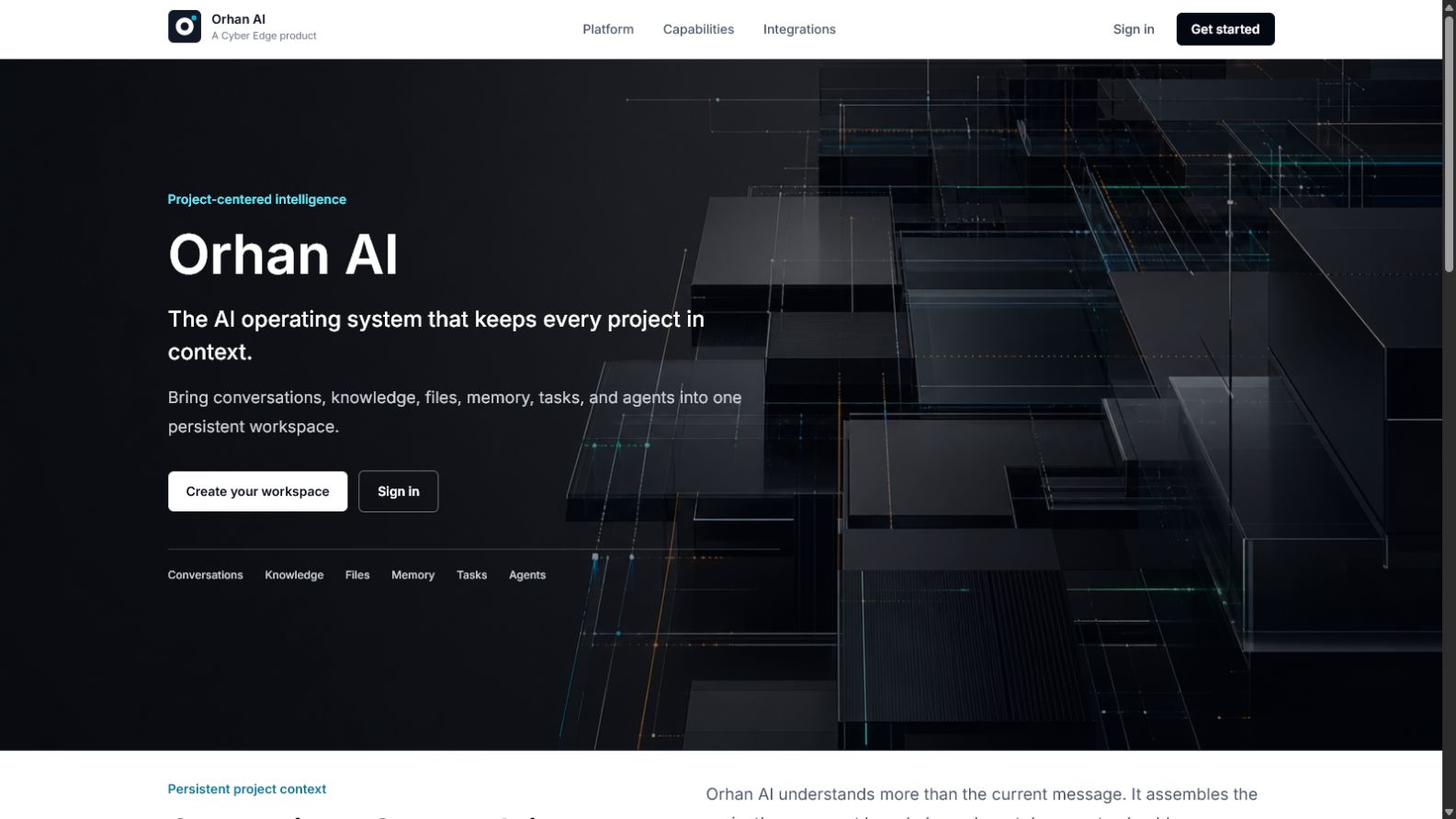
The current case study uses the supplied Orhan AI homepage image. Additional workspace screenshots can be added when approved for public display.
Technical Achievements
Designed and developed an advanced pre-release project intelligence and growth operations platform.
Implemented secure accounts, automatic workspace creation, projects, conversations, knowledge, files, memory, tasks, agents and workflow foundations.
Added campaign, content, approval, calendar, sales, analytics and daily action centre structures.
Prepared OpenRouter model configuration, prompt templates, usage tracking, token accounting, cost estimation and failure recording.
Built governed integration architecture with signed webhook support and disabled provider adapters awaiting production implementation.
Added background agent execution foundations and automated application test coverage.
Completed
Secure authentication and account management.
Automatic workspace creation.
Project creation, settings, archiving and restoration.
Project-based AI conversations.
OpenRouter AI integration and multiple selectable AI models.
Permanent project knowledge.
Project file uploads, text extraction and indexed retrieval.
Project memory with facts, preferences, decisions and instructions.
Project search, contextual retrieval and retrieval-augmented generation.
Markdown response rendering.
AI tasks, configurable agents and background agent execution.
Workflow definitions, workflow steps and workflow run controls.
Brand and product intelligence records.
Campaign planning, content studio, approvals, creative operations and content calendar foundations.
Sales leads, activities, follow-ups, scoring, attribution, conversions and duplicate merging foundations.
Analytics snapshots, experiment records, optimization recommendations and exportable report structures.
Daily action centre and workspace management foundations.
Super administrator oversight structure.
Governed integration architecture with signed webhook integration.
Responsive workspace interface.
Authorization, rate limiting, security headers, readiness monitoring and automated application test coverage.
Future Roadmap
Production hosting and public launch hardening.
Live OpenRouter provider acceptance testing.
OpenRouter API key production configuration.
Streaming AI responses.
Advanced syntax highlighting.
Vector embedding retrieval.
External provider API authentication flows and synchronization logic.
Automated social publishing, CRM synchronization and booking synchronization.
Monitoring, backups, queue supervision, alerting and deployment hardening.
Complete end-to-end acceptance testing before public production release.
Project Discussion
Share your business problem and I will help identify the right architecture, workflow and delivery path.